The Half Size Nobody Talks About: Why Your Shoes Might Be the Wrong Width, Not the Wrong Length
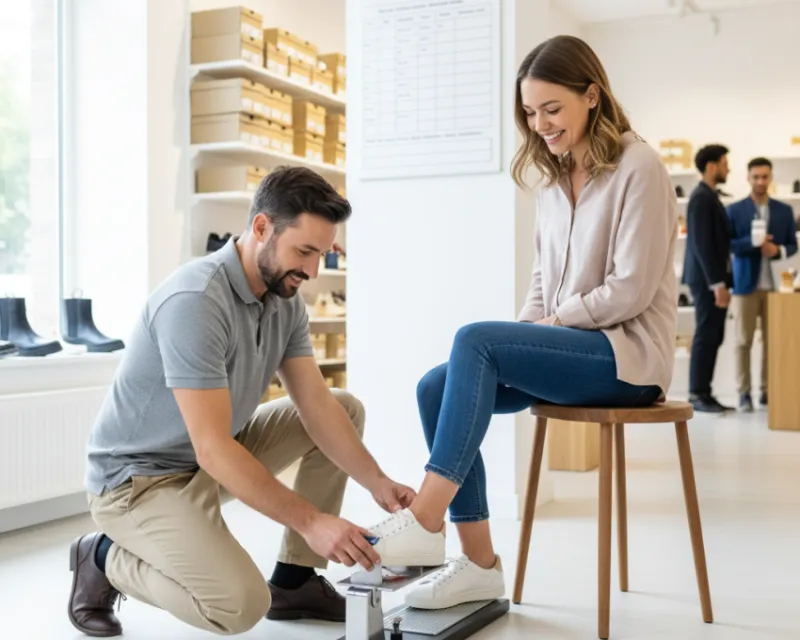
Photo: shoe shop fitter measuring foot width fitting, via thefootwearedge.com
Here's a confession to start things off: I wore shoes a full size too big for the better part of a decade. My feet ached, my heels slipped, and I blamed everything from 'cheap shoes' to 'flat arches' before a fitter in a Birmingham shoe shop glanced down and asked one question: 'Who told you your feet were that narrow?'
Turns out, plenty of us are in the same boat. Brits have spent years obsessing over length — the number on the box — while width, the letter most UK brands barely bother printing, quietly decides whether your shoes feel like a hug or a torture device.
The Sizing Lottery Is Real
If you've ever been a size 6 in one brand and a 7 in another, you're not imagining things. There's no universal standard that all footwear manufacturers adhere to. One brand's 'standard' fit is another's narrow nightmare, and some labels quietly run generous while others squeeze like the last train door.
It gets murkier with imports. European sizing converts roughly to UK lengths, but the lasts (the foot-shaped moulds shoes are built around) vary wildly. A Spanish-made pair might be cut narrow through the toe box; a German brand might feel like slippers straight away. Neither is wrong — they're just shaped for different feet.
Why So Many of Us Are Wearing the Wrong Fit
A few culprits, honestly:
- The online shift. Buying without trying means most people never get properly measured after childhood. Your feet change — they widen with age, with pregnancy, with weight changes — but the 'size 6' label from your twenties tends to stick.
- The sizing-up habit. When shoes pinch, most of us go up a size rather than across a width. It solves the squeeze but creates heel slip, toe grip issues and, ironically, blisters.
- The myth of 'breaking in'. Properly fitted shoes shouldn't need breaking in beyond softening leather. If you're enduring pain for a fortnight, that's a fit problem, not a patience problem.
Measure Your Feet at Home (Properly)
You'll need paper, a pencil, a tape measure and about ten minutes. Do it in the evening, when feet are at their most swollen — morning measurements flatter nobody.
- Stand on a sheet of paper against a wall and trace around each foot, keeping the pencil upright.
- Measure the length from heel to longest toe (which isn't always the big toe, mind).
- Measure the width across the ball of the foot at its widest point.
- Measure both feet. Most people have one foot slightly bigger — always fit to the larger one.
Width fittings in the UK typically run on a letter scale: D is standard for women (G for men), with E, F and beyond getting wider, and C and below narrower. Some brands use 'standard fit', 'wide fit' and 'extra wide' instead — less precise, but easier to shop by.
Who Actually Stocks Width Fittings on the High Street?
Good news: it's better than it used to be.
- Clarkes remains the gold standard for measured fittings, with adult options across multiple width fittings — and they'll measure you for free even if you don't buy.
- Hotter and Pavers lean comfort-first and stock generous wide-fit ranges that don't look orthopaedic.
- John Lewis department stores carry several brands with width options under one roof, which makes comparison shopping easy.
- Online, brands like Pavers, Hotter and Wide Fit specialists list fittings by letter, and returns policies make trial-and-error less painful than it once was.
Independent shoe shops are worth their weight in gold here. A good independent fitter will know which brands run narrow and which run roomy, saving you months of returns.
Is Sizing Up Ever a Good Idea?
Honest answer: rarely, and only in specific cases.
Sizing up works as a stopgap for things like winter boots where you'll wear thick socks anyway, or for feet that fall between sizes in a brand you know runs small. Half a size up in those scenarios? Sensible.
But as a permanent workaround for narrow shoes, it's a mistake. A longer shoe shifts the widest part of the sole past the widest part of your foot, so the squeeze stays — you've just added heel slip and toe-clawing as a bonus. Your foot slides forward, your toes take the brunt, and you end up with blisters in places you didn't know could blister.
If a shoe pinches across the ball of your foot, the fix is a wider fitting, not a bigger number. Full stop.
The Bottom Line
Once you know your actual measurements — both numbers — shopping transforms. You'll spot which brands suit your feet, you'll stop accepting 'they'll stretch' as gospel, and you'll understand why that £90 pair felt divine while the £40 pair was agony.
Get measured once a year or so. It takes ten minutes and might be the most valuable ten minutes your wardrobe ever spends.